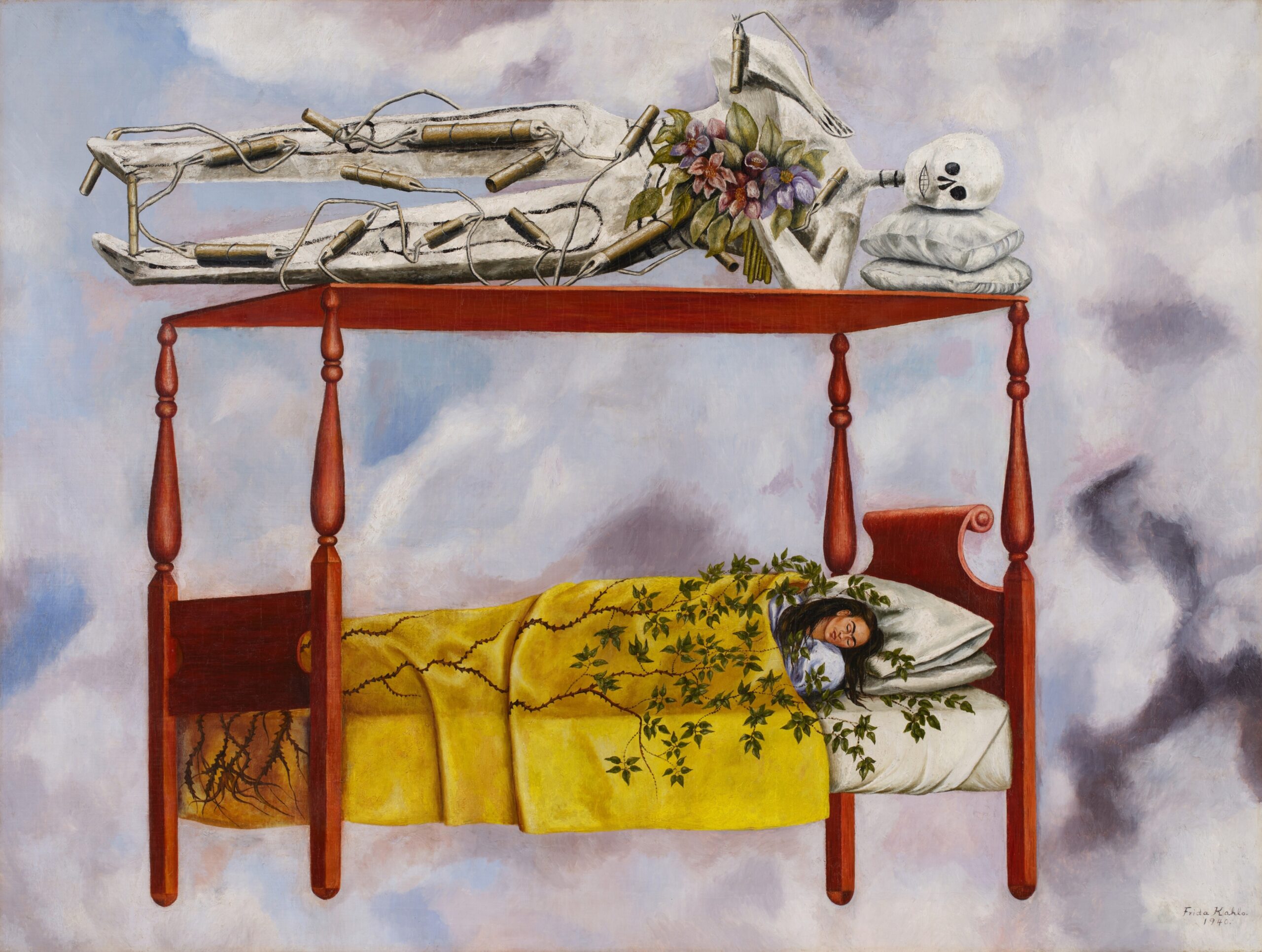
On November 20th, 2025, Sotheby’s auctioned Frida Kahlo’s El sueño (La cama) for US $47 million (US $54.7 million with premium), making the 1940 painting a record for artwork by women artists at auction, overtaking the previous record holder, Georgia O’Keeffe. The dollar amount alone is enough of a feat for this piece that is relatively young (only 80 years old), but is also a considerable increase from when it last sold in 1980 for US $51,000.
What can emerging artists take away from the resurgence of Surrealism among art collectors?
El sueño (La cama)

As I’m not an expert in Frida’s art, so I’ll pull info from Sotheby’s website of info about history, sales data and details about El sueño (La cama), with supporting info from artnet.com and fridakahlo.org. I highly recommend reading Frida Kahlo’s Letters to Nickolas Murray about her time with the Surrealists in 1939. All source info can be found listed below. Here’s an introduction to the piece to get us familiar.
“Frida Kahlo’s El sueño (La cama) from 1940 is among the most psychologically resonant and formally compelling works in the artist’s storied oeuvre, a surreal, deeply introspective self portrait that bridges personal symbolism, Mexican cultural iconography, and Surrealism. Painted during a particularly fraught moment in Kahlo’s life, El sueño (La cama), or The Dream (The Bed) in English, occupies a critical position within her practice, encapsulating her lifelong preoccupation with mortality, physicality, and the emotional complexities of selfhood.” (Source: Sotheby’s)
In 1940, Frida suffered deteriorating health problems from polio and serious complications from a bus accident in 1925. Her lover Leon Trotsky had just been killed and she was experiencing a divorce and remarriage to Diego Rivera. Beds are a recurring theme for Kahlo, as she was bedridden for long periods at this time, and a viewer can see the sense of entrapment and loneliness she must have felt during these periods of her life.
“Kahlo’s depiction of mortality in the present work is neither theoretical nor distant. Rather, it is intimate, tactile, and saturated with the emotional and spiritual registers of her experience. The suspended skeleton is often interpreted as a visualization of her anxiety about dying in her sleep, a fear all too plausible for an artist whose daily existence was shaped by chronic pain and past trauma.” (Source: Sotheby’s)
It is also worth pointing out that the skeleton above her bed in the piece is wrapped in dynamite and sleeping on two pillows. The skeleton is also designed in a paper mache style, reminiscent of Dia de los Muertos designs and Mexican/Chicano culture.
“The only thing I know is that I paint because I need to, and I paint whatever passes through my head without any other consideration.”
— Frida Kahlo (Source: fridakahlo.org)
Kahlo’s Philosophy & Fame
“There have been two great accidents in my life. One was the trolley, and the other was Diego. Diego was by far the worst.”
— Frida Kahlo (Source: fridakahlo.org)
Frida Kahlo did not consider herself a Surrealist, but was invited into the prestigious group after meeting André Breton in 1938. In the letters she wrote during her time working with the Surrealists, she expresses being miserable with Brenton and the other artists, as well as how her work was being presented and mistreated. I encourage readers to dive into Frida Kahlo’s Letters to Nickolas Muray for a glimpse into the raw emotions Frida shared while travelling “I rather sit on the floor in the market of Toluca and sell tortillas, than to have any thing to do with those “artistic” bitches of Paris.”
— Frida Kahlo’s Letters to Nickolas Muray (Source: Art Institute of Chicago)
Followers of her work can understand why she may have felt like an outsider to Surrealism, since it is, by definition, about dream-like states and pushing the boundaries of imagination, such as the works of Dalí. Whereas much of Frida’s artwork consists of self portraits often created while she was bedridden, expressing pain and isolation she also deeply wanted her work to be seen. So, like many of us would, she endured to share it with the world.
Her popularity only grew after her death in 1953. She became an icon of feminist movements starting in the 1970s, Hayden Herrera published A Biography of Frida Kahlo in 1983, and in 2002 the Academy Award winning film Frida, with Salma Hayek and Alfred Molina, was released. This is only a fraction of what her name and image have used for political movements, inspiration for other artists, and various products. Frida is certainly not the first icon to live on after death, but one could wonder what Frida herself would think of her fame today.


Frida Kahlo by her bed (with kitten) Selma Hayek in Frida (2002)
Now it is 2025 and Frida’s catalogue of work, and her image, have arguably reached the level of a modern icon and this year one Kahlo piece now sells for US $47 million. We have yet to mention her other artwork that has been sold for undisclosed amounts to private collectors over the years and a quick search about this sale will show larger discussions regarding these very large and anonymous art deals at these events, as well as their impact on the art consumption culture. It’s also worth noting that the image of Frida has only grown since the feminist movements of the 1970s, and her self portrait and influences can be seen in an incalculable number of artists’ work today.
There’s a palpable irony in the art community when a beloved icon reaches a level of notoriety and monetary value that the vast majority of us cannot fathom in our day to day lives. What one person may see as market trends, others can also translate into exploitation of an artist’s name and image. In Frida’s case, we can also see what her image has become after her death. She has become an inspirational figure for women’s rights and Chicano art globally, despite her artwork being very much about pain, loneliness, and identity in her life under Diego’s shadow. Perhaps this is another milestone in a long journey of unintended successes for a woman trying to cope with her realities.
The Resurgence of Surrealism
While much of the attention during the auction on November 20th was given to Frida and El sueño (La cama), what can also be taken away from that evening is an intriguing success for Surrealist and Expressionist art in the market, as well as a continued emergence of collectors interested in more art from women and and Latin artists. El sueño (La cama) was included in Sotheby’s “Exquisite Corpus” evening auction among quite a few other Surrealist pieces.
“Among the most distinguished private collections of Surrealist art, Exquisite Corpus represents the culmination of a lifetime’s engagement with one of the twentieth century’s most revolutionary artistic movements. Assembled over four decades with a connoisseurial eye and unwavering dedication, the collection traces the movement’s imaginative arc and recalls the collaborative Surrealist game ‘Exquisite Corpse,’ in which artists’ successive sketches coalesced into unexpected and fantastical forms. Rarely seen and long preserved in private hands, the collection stands as a testament to Surrealism’s enduring capacity to challenge perception and provoke critical reflection, and affirms its profound relevance in the modern era.” (Source: Sotheby’s)
Several pieces from women of various cultural backgrounds were included in the sale that evening for equally impressive sale prices, including; Valentine Hugo, Kay Sage, Dorothea Tanning. Many critics and writers describe the art industry in a place of reconsidering the women of the Surrealist movement, and these record breaking auction sales seem to emphasize that momentum. The “Exquisite Corpus” sale totaled US $98.1 million, right at the high end of its estimate of US $66.2 million to US $98.9 million.
Christie’s Jussi Pylkkanen commented that evening about the state of the art market and what he witnessed at the November 20th auction.
“Tonight’s sale at Sotheby’s clearly illustrated that the market has turned a corner. Consignors can be confident that the global art market is properly back on its feet. It’s also great to see that the beautiful theater of auction has returned.”
– Jussi Pylkkanen (Source: news.artnet.com)
It’s possible to make parallels between the time of Frida and similar artists’ desire for expression in today’s artwork. Many popular artists are exploring new ways to create, breaking away from traditional forms and constantly evolving. We all struggle in our own ways with the world around us right now and artists are our catalyst for feelings we may not be able to put into words. Experiences, storytelling, and perspective are now commonplace among emerging artists and maybe collectors are searching for more meaning in the art they choose more than ever. Perhaps in a time where the world is tightening its grip, as in Frida’s time, is when we’re looking for deeper expression and individuality in the art around us. Turning to symbols, myths and dreams as a reaction to destruction and difficulties in our worlds.
Thoughts for Artists
While this article is not predictive of the art market, it’s worth exploring the increased popularity of Surrealist and Expressionist artwork among collectors and how emerging artists can ride this wave of momentum for their own artwork. We take away some assumptions from the November 20th auction that the global market for artwork is increasing in strength and there is more interest in non traditional art among collectors than ever, especially pieces that explore emotional context and cultural identity. We can also see what some may consider non-traditional artforms, such from the Surrealist artists of the 1940s to more modern artists and their uses of Expressionism. This may only be just beginning to have new opportunities to engage collectors and evoke emotion to larger audiences than ever before.
“I used to think I was the strangest person in the world but then I thought there are so many people in the world, there must be someone just like me who feels bizarre and flawed in the same ways I do. I would imagine her, and imagine that she must be out there thinking of me too. Well, I hope that if you are out there and read this and know that, yes, it’s true I’m here, and I’m just as strange as you.”
— Frida Kahlo (Source: fridakahlo.org)
For my emerging artists trying to make it in the industry, I leave you with some thoughts for introspection:
- How are we using cultural identity in our art to evoke emotion to viewers?
- Are we holding back our emotional exploration and vulnerability in our work for fear of not being marketable? In what ways?
- What inspiration can we draw from Frida and other re-emerging Surrealist artists’ to curate our own collections, in a way that is true to our sense of self?
Sources:
*Bernard G. Silberstein, Frida Kahlo in Her Bedroom, circa 1940, Detroit Institute of Arts © Detroit Institute of Arts / Bridgeman Images
*Frida, 2002, Lionsgate Films, Miramax, and Ventanarosa Productions
*”Sotheby’s Exquisite Corpus: Surrealist Treasures from a Private Collection”, Sothebys.com, November 20, 2025, https://www.sothebys.com/en/buy/auction/2025/exquisite-corpus-evening-auction/el-sueno-la-cama
*Kinsella, Eileen, “At $304.6 Million Sotheby’s Tripleheader, Van Gogh and Kahlo Soar, as the Market Bounces Back”, Artnet.com, November 20, 2025, https://news.artnet.com/market/sothebys-modern-pritzker-exquisite-corpse-auction-results-2716914
*Kinsella, Eileen & Boucher, Brian, “Frida Kahlo Masterpiece Sells for $54.7 Million, New Auction Record for Artwork by a Woman”, Artnet.com, November 20, 2025, https://news.artnet.com/market/frida-kahlo-el-sueno-sothebys-auction-2690737
*Wong, Kayan,“Frida Kahlo’s self-portrait sells for US$54.7m, setting auction record for a female artist”, thevalue.com, November 21, 2025, https://en.thevalue.com/articles/frida-kahlo-painting-smashes-auction-record-sothebys-ny-2025
*”Frida Kahlo’s Letters to Nickolas Muray”, Art Institute of Chicago, https://www.artic.edu/articles/1189/frida-kahlos-letters-to-nickolas-muray
*Inspiration from Benzine, Vittoria, “Who Are the 10 Most Expensive Women Artists at Auction?”, Artnet.com, December 2, 2025, https://news.artnet.com/market/10-most-expensive-women-artists-2722693
*Inspiration from Ulaby, Neda, “A Frida Kahlo painting broke records at auction on Thursday”, NPR News, November 20, 2025, https://www.npr.org/2025/11/19/nx-s1-5584087/frida-kahlo-auction-record-sothebys-el-sueno-la-cama
*Quotes from and about Frida Kahlo from www.fridakahlo.org